Objective Training: Improving the Odds
Developing the skill through clarity, consistency, and objective training.
Progress in riding rarely comes from chasing perfect moments. It comes from improving the odds through clarity, repetition, and honest feedback from both horse and rider.
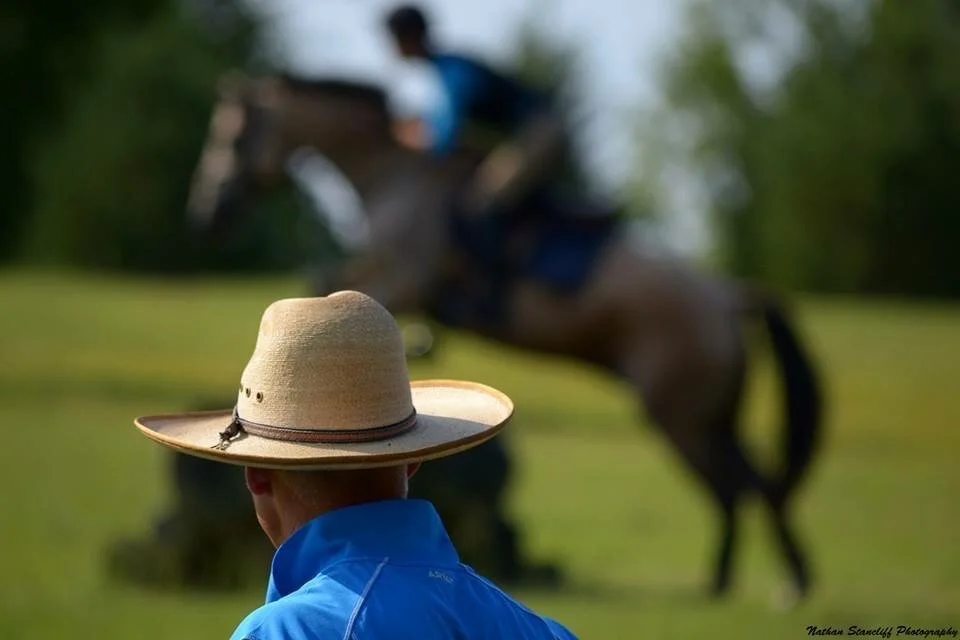
Photo credit Nathan Stancliff
Riding is one of those skills you never truly master. Mastery is not a destination—it’s a way of operating. The pursuit of perfection can feel as abstract and overwhelming as finishing a painting before the brush ever touches the canvas.
First, you have to get your brush wet.
Whether you ride for pleasure or compete at a high level, we all carry goals. Dreams of winning ribbons or reaching a certain standard can be motivating. But they can also become frustrating when our equine partner doesn’t quite fit the picture we imagined.
Often that frustration doesn’t come from lack of effort—it comes from lack of clarity.
To make a goal attainable, there must be accountability in the steps that lead toward it. Even if your goal is simply to enjoy the ride more, you must first understand what makes it enjoyable. From there, you can begin developing a skill set that improves the odds of reaching that experience through smaller, attainable, objective exercises.
Riding, like art, offers infinite possibilities. Each partnership between horse and rider is unique. But without measured steps, progress becomes ambiguous. Anyone chasing the perfect picture without a system is essentially working in the dark—and that uncertainty often leads to discouragement.
Take a goal like winning a Five-Star event. You may share that ambition with dozens of other riders. What separates those who progress from those who stall isn’t entitlement or luck—it’s preparation, consistency, and acceptance of chance.
We control our actions, not the outcome.
Riding, by nature, becomes a game of odds.
Progress has always been my greatest motivator. I define progress as increasing the odds of a desirable outcome over time. Without adjusting routine or following a program, results tend to stay the same—often vague and unsatisfying.
It’s easy to mistake occasional highs for progress, but those moments alone don’t build readiness or reliability.
Jumping a single big fence doesn’t mean you’re prepared to ride a full course. Executing one movement well doesn’t guarantee success in a complete dressage test.
Skill is what improves the odds.
And skill is built through repetition, honesty, and time.
The Starting Point
Every meaningful training program begins with a clear starting point. Before we can build toward improvement, we must understand where we actually are—not where we hope to be.
This requires humility, patience, and curiosity.
Progress rarely begins with dramatic breakthroughs. More often it begins with quiet observation.
Finding the Limiting Factor
To improve skill, you must identify the limiting factor within your partnership.
The limiting factor is the single element currently holding back progress. It might be balance, confidence, timing, clarity of aids, rider understanding, or even performance anxiety.
Discovering it requires looking honestly at patterns over time—not just isolated rides.
Many riders focus on symptoms rather than causes. A missed distance, a crooked transition, or a refusal at a fence may simply be the visible result of a deeper limitation.
When the true limiting factor is addressed, many other problems begin to resolve naturally.
“Undesirable results are not failures - they are information.”
Objective Exercises
Once the limiting factor becomes clear, training can become purposeful.
Objective exercises allow both horse and rider to measure improvement. These exercises simplify the task at hand so that progress becomes visible and repeatable.
Instead of chasing a perfect round or perfect test, we begin to focus on individual elements that contribute to the larger picture.
Small, repeatable successes gradually build skill and confidence.
Over time, these pieces begin to connect.
Big Goals and Short-Term Attainable Goals
Big goals provide direction.
But short-term attainable goals provide momentum.
Experience is the greatest teacher. Learning from your own rides—and from the experience of others—shortens the learning curve and reduces unnecessary struggle.
With patience, repetition, and education, riding skills can improve dramatically when attention is placed on the limiting factor rather than the outcome.
Progress only continues when we look clearly at both strengths and weaknesses.
As a competitor, trainer, and coach, I design exercises that challenge known limitations while uncovering new ones. Undesirable results are not failures—they are information.
Your horse is always seeking comfort and clarity. In every result, good or bad, there is feedback guiding you toward the next best action.
Anyone with experience has felt both the highs and the lows. What matters is how we use that experience to improve the odds of future success.
Goals will evolve as new information is gained. Breaking them down makes progress visible and keeps momentum alive—fueling the journey not only with achievement, but with integrity.
“Progress in riding is simply improving the odds of a desirable outcome over time.”
The Balance Box
A signature exercise for developing balance, clarity, and connection
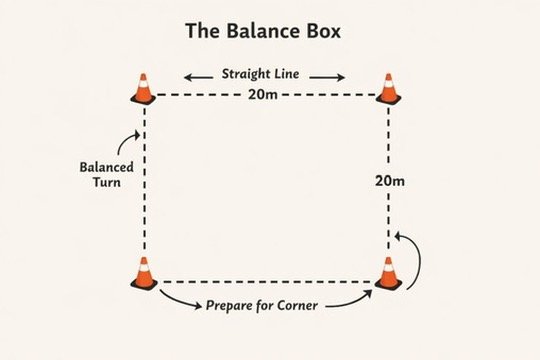
The Balance Box
One of my favorite exercises for both horses and riders is something I call the Balance Box. It is simple to set up and incredibly revealing.
Place four cones or markers in the arena to create a square approximately 20 meters by 20 meters. Each side of the square becomes a straight line, and each corner becomes a deliberate turn.
Ride the square at the walk first.
Your focus should be on three things:
Straightness on each line
Balance before the turn
Clarity of direction through the corner
As you approach each marker, prepare the horse for the turn by rebalancing slightly before the corner. The turn itself should feel intentional, not drifting or falling through the shoulder.
Once the horse understands the pattern, repeat the exercise at the trot and eventually at the canter.
Increasing the Difficulty
To increase the difficulty of the Balance Box, you can integrate transitions at predetermined locations.
For example, you might ask for a transition midway down the line between two corners, or within the corner itself.
What matters most is that you stay consistent with what you ask and where you ask it. Consistency creates a reliable pool of information—not only for you as the rider, but for your horse as well.
Over time, this consistency allows both horse and rider to anticipate the exercise with greater clarity, revealing patterns in balance, responsiveness, and understanding.
What the Balance Box Reveals
This simple pattern often exposes the true limiting factor in a partnership.
If the horse drifts, it may reveal issues in straightness or rider alignment.
If the horse rushes through the turn, balance may be missing.
If the horse resists the turn, it may indicate confusion or tension.
Instead of forcing the result, the rider can observe the feedback and make small adjustments.
Bringing It Back to Objective Training
Exercises like the Balance Box remind us that progress rarely comes from chasing bigger movements or bigger fences. It comes from understanding the small details that influence every ride.
When riders approach training objectively—repeating patterns, asking questions in the same places, and observing the results—they begin to gather meaningful information. That information reveals strengths, exposes limitations, and guides the next step in the process.
Over time, both horse and rider begin to move with greater clarity and confidence. What once felt complicated becomes organized, and what once felt uncertain becomes predictable.
In this way, training becomes less about forcing results and more about improving the odds of success through thoughtful preparation.
And when those odds begin to shift in your favor, the picture you once imagined starts to appear—one ride at a time.
"Thoughtful riding begins with thoughtful questions.”
Eric Dierks is a trainer, instructor, and competitor based at Stonehedge Farm in Union Grove, Wisconsin. His work focuses on helping riders develop clarity, balance, and confidence through classical horsemanship principles and objective training methods that strengthen the partnership between horse and rider.